

1 Killing site(s)
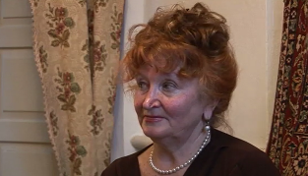
Nonna Z., a Jewish survivor born in 1938: "The very day after their arrival, the Germans announced that Jews were required to wear the Star of David and report to the Kommandantur to register. After registration, we were told that all Jews would soon be sent to Melitopol. The administration declared that anyone who refused to register would be punished.
Because my father had worked in Western Ukraine just before the war, he already knew what was happening to the Jews in Poland. My father had told us about it. But people did not believe any of it; they thought the Germans were a civilized, educated people... That was their mistake. Our family would’ve liked to evacuate, but we had neither the money nor a cart.
My mother told us not to wear the star; it was our way of protesting. Wearing the star meant you could walk around the town, but it also meant that anyone could tell you were Jewish. That is what our mother explained to us. Naturally, after these announcements, we began to worry about being denounced, which is why we immediately went into hiding. My mother and one of her friends understood that we were in danger and took us into hiding; we didn’t understand what was happening. To get food, my mother would disguise herself as an old woman so as not to be recognized and go out to the market to barter. We were quite poor and we had very little to trade other than my father’s instrument, scraps of fabric—anything we could to get a piece of bread. We survived thanks to the help of our neighbor, Karp Matveyevich, and the Dulin family, who hid and fed us.
Then one day, notices were posted throughout the town—on every post, in every courtyard—announcing that Jews were to gather at the market square on October 19, carrying only strict necessities. But people brought their most precious belongings and their documents. At the market square, all these possessions were loaded onto carts. Then they were marched to the Merlikova Balka ravine. People who understood what was happening and tried to escape along the way were shot. Until the very last moment, people didn’t believe they were going to be killed. The shooting lasted all day." (Testimony N°YIU423U, interviewed in Berdyansk, on 08/01/2007)
" […] We, citizens of the city of Osipenko [today Berdyansk], representatives of public organizations and military units, have drawn up this act on the following: […]
On October 9, the local Gestapo branch issued an order according to which the entire Jewish population was required to wear a special distinctive mark — a white armband with a six-pointed star.
On October 10, the Gestapo ordered all Jews in the city to report to the Market Square with luggage, ostensibly for relocation to other places. On the same day, the entire Jewish population was taken to Merlikova Balka, located 5 km from the city, and shot without exception, including the elderly, young children, and pregnant women. In total, on that day, approximately 900 people were shot.
Gold and silver items belonging to the victims were taken by gendarmes and Gestapo officers, and the rest of the property was distributed to policemen and residents. Among those shot were: doctor Gershovich Ya.S., his wife, three daughters, and an infant; pediatrician Kraindel V.A. and her 60-year-old mother; dentist Libenstein, her husband, and two children; dentist Samoilovich; dentist of the Azov-Black Sea Plant Sheivakhovich; physiologist doctor Levina; worker at the Pervomaisky Plant Lapidus; and others.
Over the course of a month, the entire Jewish population was exterminated without exception, and later Jewish women who were married to Russians were also shot. Thus perished: surgeon doctor Veselovskaya; pediatrician Kudryavtseva with two daughters; dentist Tsukerman; nurse Samburskaya; and others. […] " [Act on atrocities and crimes committed by German-fascist troops and authorities in the city of Osipenko (Berdyansk) during the occupation from October 7, 1941, to September 16, 1943. Drawn by Commission for the History of the Great Patriotic War on September 20, 1943, p.43 ; TsDAHO Fond 240, Opis 2772, Delo 82/copy USHMM RG-22.016]
Berdyansk is a port city located in the Zaporizhzhia region of southeastern Ukraine, situated on the northern coast of the Sea of Azov. Founded in 1827 on the site of a small fishing settlement initially known as Kutur-Ogly (and briefly Novo-Nogaisk), the settlement rapidly developed around its newly constructed harbor and was granted official city status in 1835 under the name Berdyansk. Between July 1939 and 1958, the city was renamed Osypenko (Osipenko) in honor of the military aviator and Hero of the Soviet Union Polina Osypenko, who was born in the nearby village of Nove Spasove (itself renamed Osypenko). The city’s historical name, Berdyansk, was restored in 1958.
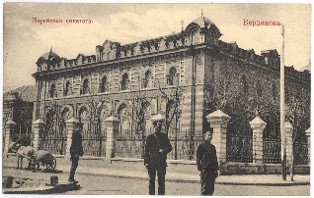
Following the opening of the port in the early 19th century, a permanent Jewish community established itself in the city, growing from 572 Jewish residents in 1847 to 3,861 by the 1897 Imperial Russian census, when Jews constituted roughly 14.6% of the total urban population (26,480 residents). Pre-war Jewish life centered around two synagogues, religious schools (cheders and a Talmud Torah), commercial enterprises, and mutual aid societies. During the early Soviet period, urbanization and migration to major industrial centers led to a demographic decline; by the 1939 Soviet census, the Jewish population of Osipenko (Berdyansk) stood at 2,393 individuals, accounting for approximately 4.6% of the city’s inhabitants prior to the outbreak of the Second World War.
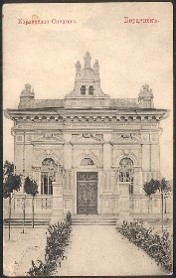
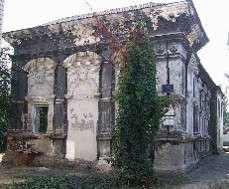
Before the war, Berdyansk was also home to an influential Crimean Karaite (Karaim) merchant community, which had flourished since the 19th century through maritime trade and was spiritually centered around a monumental Kenesa built in 1899.
Berdyansk was occupied by German forces on October 7, 1941. By that time, many local Jews had managed to evacuate, leaving approximately 1,000 Jewish individuals in the city.
On October 9, a notice was posted in the city center ordering all residents of Jewish nationality to register with local authorities and wear a distinctive mark. Nonna Z., born in 1938, a Jewish survivor interviewed by Yahad - In Unum, recalled that as early as the day following their arrival, the Germans ordered Jews to wear a Star of David and report to the Kommandantur.
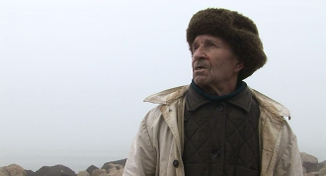
On October 19 (or October 10, according to some sources), an order required all Jewish residents to assemble at the city’s Market Square with their belongings and provisions, ostensibly for resettlement. Deceptive rumors regarding their destination circulated widely: Volodymyr S., born in 1925, recalled announcements broadcast over municipal loudspeakers stating that Jews were being relocated to Palestine, whereas Nonna remembered hearing that they were to be sent to Melitopol.
Misled by this deception, the Jewish population gathered as ordered. On that day, Volodymyr witnessed the Jewish family of Mr. Bazhan, an employee at the NKVD sanatorium, setting off by cart toward the market square, carrying their belongings and appearing in high spirits. Upon arrival, the assembled Jews were cordoned off by German soldiers and local auxiliary police. Carts were brought in to transport their luggage, while the victims, numbering over 900 people, were force-marched or transported to Merlikova Balka, the site of a former NKVD children’s sanatorium.
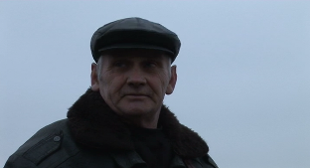
At the site, personal belongings and valuables were confiscated and stacked near a building on the edge of the ravine, while the victims were locked inside the premises. Mass shootings began that same day. According to the testimony of Viktor, born in 1930, local memory recorded particular cruelties: "People said that the children were killed first; a substance, a sort of ointment, was applied under their noses, and they died instantly."
Subsequently, adults were led in groups of approximately 100 people to the edge of the ravine and shot by members of Sonderkommando 10a, a subunit of Einsatzgruppe D, while the local police maintained perimeter security. Almost the entire Jewish population of Berdyansk was exterminated that day at Merlikova Balka ravine. However, systematic roundups continued for nearly a month as hidden individuals were tracked down. By early 1942, intermarried Jews were also targeted and killed. As Nonna Z., born in 1938, recalled: "After the mass shooting on October 19, they continued hunting down every last Jew. The Germans hunted and killed even the Jewish children who had managed to be baptized."
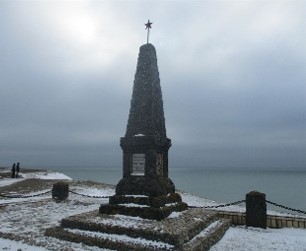
Volodymyr S., born in 1925, recalled that during the 1960s, rising sea levels prompted a sanitary reinterment of the victims at Merlikova Balka ravine, with a portion of the exhumed remains transferred to the municipal cemetery. In September 2016, a second episode of coastal erosion and landslips again exposed human remains at the site. Following an emergency exhumation, these remains were reburied near the memorial dedicated to the ’Victims of Fascism,’ erected approximately 150 meters from the original mass grave.
Unlike the Ashkenazi Jewish population of Berdyansk, who were targeted and killed at Merlikova Balka in October 1941, local Karaites were reportedly exempted from anti-Jewish measures by German occupation policy. Having been categorized by as ethnically non-Jewish, the Karaites would thereby have been spared from the massacres that devastated the city’s Rabbinic Jewish community.
Do you have additional information regarding a village that you would like to share with Yahad ?
Please contact us at contact@yahadinunum.org
or by calling Yahad – In Unum at +33 (0) 1 53 20 13 17