

1 Killing site(s)
Oleksandra R., born in 1932: "The Jews were kept in the club overnight, and then they were taken to the well to be shot. It was in the early fall. Because there were not enough men in our village, the Romanians ordered three local women, including my mother, to help. These women had to drag the bodies of the people who’d been killed while trying to run away into the pit. That is how my mother saw the whole shooting. She told us later that most of the people were shot, but some were stabbed with bayonets, and others even jumped into the well alive before any bullets hit them. After it was over, she also had to cover the pit with some earth. I remember she cried so much when she came home. The next day, they forced her to go back and cover the pit better because the ground was still moving. After that, my mother and I talked about that day many times, remembering what happened and thinking about our Jewish neighbors and friends." (Testimony n°YIU1236U, interviewed in Hanno-Pokrovka, on July 22, 2011)
"We, the undersigned, Commission to investigate atrocities committed by Romanian-German occupiers during the occupation of Ukraine in 1941 […] have drawn up the present act establishing that on this day, the aforementioned commission conducted an excavation of the artesian well in the village of Friling as well as of a grave in the vegetable garden of the Friling club.
The opening of the well revealed 61 bodies of people of various ages, 42 of which were mummified. Some bodies were identified by collective farm workers from Friling, Yerofey Klapshey and Esther Shashlyannikova. The names of the identified individuals are as follows: Muzyka Tuba, Shereshevsky Fishel, Shereshevskaya Polya, Shereshevskaya Tanya, Zinenberg Leyb, Zinenberg Rosa, Frumker Sonia, and Kazimirova Sheyva.
The majority of the bodies had fractured skulls. According to witnesses, young children had been thrown into the well alive. Two children’s bodies were found intact.
It was not possible to extract the remaining bodies from the artesian well because it is 70 meters deep and was in danger of collapsing, and the large volume of gas emitted by the decomposing bodies posed a mortal danger to the workers. For this reason, the excavations were halted.
According to witnesses, there are 116 bodies in this well, 55 of which could not be extracted. The extracted bodies are those of 34 women, 6 men, and 21 children.
In addition, 5 bodies were found in the vegetable garden near the klub [Cultural Center], including the bodies of two women, the body of one man, and those of two children. Thus, a total of 66 bodies were exhumed.
In addition to the victims from the village of Friling in 1941, the bodies of three prisoners of war tortured to death in 1944 were found in a hollow. All three bodies had fractured skulls, evidently caused by a blunt instrument. The names of these prisoners of war are unknown.
All the bodies were buried in a mass grave. Thus, 124 people were put to death, including 23 children, along with three prisoners of war." [Act No. 6 drawn up by the Extraordinary State Soviet Commission (ChGK), on April 21, 1944; Copy USHMM RG.22-002M, Reel 6 (32), p.29]
Hanno Pokrovka, which today incorporates the territory of the former Jewish agricultural colony of Friling, a Yiddish name meaning Spring, later renamed Vesennee in 1944, is located approximately 84 km (52 mi) north of Odesa. The village, which was historically situated in the Shyriaieve district, now belongs to the Konopleane community within the Berezivka district of Odesa Oblast.
During the 19th century, this territory belonged to the Kherson Governorate of the Russian Empire. It was part of the imperial zone designated for Jewish agricultural colonization. Following the revolution, it became part of the Ukrainian Soviet Socialist Republic. During the Soviet period, notably in the 1920s and 1930s, the area underwent significant agricultural development, leading to the reorganization of local settlements and the creation of collective farms, also known as kolkhozes.
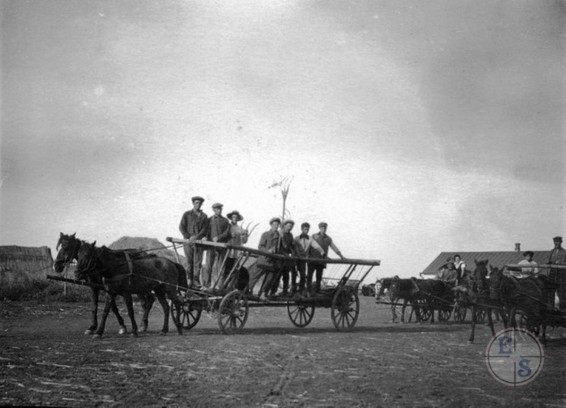
During the 1930s, Friling was home to 481 residents. While the exact size of the Jewish population living there on the eve of the war remains unknown, local witnesses interviewed by Yahad - In Unum recalled that numerous Jewish families lived there alongside three Slavic families. Most of local Jews worked in the prosperous wine-producing kolkhoz, while others were involved in trade, such as a Jewish man named Leiba who ran a local store selling various goods. The community also maintained a club building equipped with electricity, which was a rarity at the time.
Hanno-Pokrovka, like surrounding area, was occupied by German troops in early August 1941 and, at the end of the same month, was transferred to the Romanian civilian administration as part of the Transnistria Governorate.
According to local witnesses interviewed by Yahad, after the outbreak of the war, local Jews evacuated Friling. However, shortly afterward, presumably in September 1941, they were brought back under guard alongside other Jews captured during the evacuation. According to Alexandra R., born in 1932, the group mainly consisted of elderly people and families with children, but there were no young Jewish men.
Upon arriving at the colony, the victims were locked up in the local klub building [Cultural Center]. Any local Jews who tried to return and check on their homes were also taken there. The captives were held there for a short period, ranging from one to three days at most. According to archival sources, a pit containing the remains of five people, including two women, one man, and two children, was discovered in the vegetable garden near the klub at the end of the war. It is possible that these victims were among those who had been confined in the klub during that period of detention.
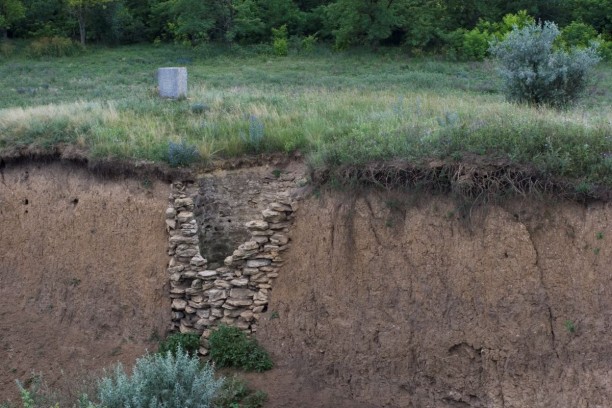
Shortly thereafter, in late September 1941, or on September 24 according to some sources, all the detainees were marched in a column to a deep, large well situated on the outskirts of the village. There, they were lined up at the edge of the well and shot in small groups, fully dressed, by several executioners, while other perpetrators guarded the perimeter to prevent any of the victims from escaping. Three local women were forced to assist by dragging the bodies of those who had tried to escape, and were killed nearby, back to the well. After the shooting, the well was lightly covered with earth by the same women, and then covered more securely the following day because the ground continued to move.
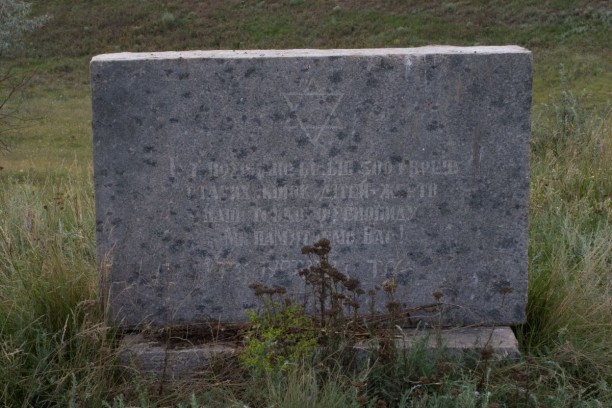
The available sources differ regarding the exact number of victims shot in Friling. While Soviet archival sources indicate that the well contained the remains of 116 Jews, other sources give slightly different numbers, ranging from 108 to 133 victims. The monument erected today near the killing site is, however, dedicated to over 500 victims buried there. Thus, this wide variation in numbers can be explained either by other victims from neighboring localities being included in the memorial count, by additional shootings conducted on the site that were not mentioned in archival sources, or by the fact that victims from other nearby killing sites were later exhumed and reburied at this same location.
Do you have additional information regarding a village that you would like to share with Yahad ?
Please contact us at contact@yahadinunum.org
or by calling Yahad – In Unum at +33 (0) 1 53 20 13 17