
.jpg&f=jpg)
.jpg&f=jpg)
.jpg&f=jpg)
.jpg&f=jpg)
.jpg&f=jpg)
.jpg&f=jpg)
.jpg&f=jpg)
.jpg&f=jpg)
.jpg&f=jpg)
.jpg&f=jpg)
.jpg&f=jpg)
.jpg&f=jpg)
.jpg&f=jpg)
.jpg&f=jpg)
.jpg&f=jpg)
1 Killing site(s)
Zdzisław W., born in 1927: "Right after their arrival, the Germans ordered that all mentally ill and disabled people be registered, claiming they would receive care. Someone went directly to their homes to put their names on a list, but they were all transported to Szczerba and murdered. Then, the ghetto was created. It was enclosed by barbed wire, though it is not clear who put it up. We Poles whose homes fell inside the ghetto boundaries were forced to leave. On the day of the ghetto liquidation in the autumn of 1942, the Germans gathered all the Jews and marched them toward Grajewo, though I do not know their final destination. There were carts, but the men, women, and children walked, most carrying a few belongings.
That same day, I saw three Germans beat a Jewish woman to death in the street. Fifteen minutes later, a messenger arrived to requisition me to help with the transport. Wanting to evade it, I lied and told him I didn’t have my horse and would come once I retrieved it. When I returned later, I was told I was no longer needed. By then, carts were already carrying away the Jewish belongings left behind in the ghetto. No one was allowed to take anything for themselves. Some tried, and three or four people were shot for it. Only two Jewish doctors survived the war: Shohr and Herman. It was said they had saved a German, and that is why they were spared." (Witness N°YIU1146P, interviewed in Augustów, on September 18, 2020)
Augustów is a town in north-eastern Poland, located approximately 90 km (56 mi) north of Białystok. Documented Jewish presence in Augustów dates back to 1630, with early residents mainly engaged in fishing and commerce. An autonomous Jewish community was established in 1674, featuring its own wooden synagogue and ritual bath. During this same period, the town established the Old Jewish cemetery on what is now Waryńskiego Street. This burial ground remained active until the early 19th century, when it was superseded by the opening of the New Jewish cemetery on Zarzecze Street.
By the 18th century, the town served as the head of a "county kehilla," overseeing Jewish populations in the surrounding rural and urban areas. Local Jewish residents mostly worked in fishing, small trade, and crafts like tailoring, tanning, and food processing. By the mid-1820s, some also found work building the Augustów Canal. In 1840, a striking neoclassical building known as the Great Synagogue (Beit ha-Knesset ha-Gadol) was built at the corner of Polna and Zygmuntowska streets. It stood near an older synagogue located at the intersection of Zygmuntowska and Szkolna streets. By the early 1900s, three additional synagogues were active in Augustów: one near Mostowa Street, another between 3 Maja and ks. Skorupki streets, and a third—the Jatke Kalniz Beit Midrasz—built between 1925 and 1928 on Żabia Street.
By the late 19th century, a wealthy Jewish financial elite had emerged, owning nearly 98% of the town’s industrial plants, including breweries, brickyards, tanneries, and sawmills. The Jewish community also included many shopkeepers, landlords, alcohol vendors, and suppliers for the local Russian military garrison. A smaller number worked in healthcare, education, and local administration. In 1921, the Augustow Community consisted of just 2,261 members – mainly craftsmen who dealt with tailoring. In 1939 there were approximately 4,000 Jews who lived in Augustów.
Augustów was occupied by Soviet troops in September 1939. By September 1940, wartime disruptions under Soviet rule, including refugee flight, deportations to the interior, and forced labor conscription, left only 2,906 Jewish individuals documented in the Augustów district. On June 22, 1941, the town was invaded by German troops.
Anti-Jewish policies and killings began immediately, resulting in the deaths of one-third to one-half of Augustów’s Jewish population during the summer of 1941. On June 24, 1941, 15 Jews and 15 Russians from the town’s retreat center were murdered. Shortly thereafter, Einsatzgruppen units under Hans-Joachim Böhme, commander of the Tilsit State Police, took over the killings. On June 27, under the pretext of combating communism, 100 predominantly Jewish residents were arrested, followed by several more arrests shortly after. These captives were either killed immediately or detained until July 3, when they were massacred alongside other victims. On that day, a total of 300 to 316 people, mostly Jews, were shot in the Augustów Forest by an operational unit led by the Grenzkommissar of the Suwałki border police, with assistance from soldiers of the 87th Infantry Regiment’s intelligence branch. On August 15, 1941, simultaneously with the ghetto’s establishment, between 800 and 1,650 Jewish men aged 13 to 65 were shot in the Szczebra area of the Augustów Forest.
The remaining Jewish residents of Augustów, consisting mostly of women, children, and craftsmen, were confined to a ghetto established on Barracks Street alongside Jews brought in from neighboring areas, including Sztabin, Lipsk nad Biebrzą, Raczki, and Dowspuda. In total, approximately 2,000 people were held there. Located on the former settlement of the local sawmill laborers, the ghetto was enclosed by a fence and patrolled by German Gendarmes and Polish guards. Between 1941 and 1942, severe overcrowding, hunger, epidemics, and isolated killings resulted in the deaths of several dozen Jews in the ghetto. Historical sources indicate that the remains of approximately 60 victims were buried on Waryńskiego Street, at the site of the town’s historic 17th-century Old Jewish cemetery. Although this older burial ground had long been inactive, its location fell directly within or adjacent to the wartime ghetto boundaries, leading to its reuse for the victims.
In June 1942, German forces reduced the ghetto’s population by transferring numerous young Jewish women to Grajewo. The ghetto was liquidated on November 2, 1942, leaving only a few Christian converts permitted to stay in town. Written sources state that during the ghetto liquidation, the sick and elderly were burned alive in the ghetto hospital and their homes. However, local witnesses interviewed by Yahad-In Unum recalled that these individuals were loaded onto carts and transported alongside the marching Jews to a transit camp in Bogusze village, near the Prostken train station. In addition to the Augustów population, between 5,000 and 9,000 Jews from the broader region were concentrated at the camp that day. From the Bogusze camp, between 3,000 and 5,000 prisoners were deported to the Treblinka killing center on December 15–16, 1942, followed by the final 2,000 captives sent to Auschwitz on January 3, 1943.
Marian U., born in 1930, recalls that after the liquidation of the ghetto, the Germans sold off remaining Jewish property. Locals could buy leftover furniture and items. Waiting outside the ghetto gate, people were let in by the Germans in groups of ten to make their purchases.
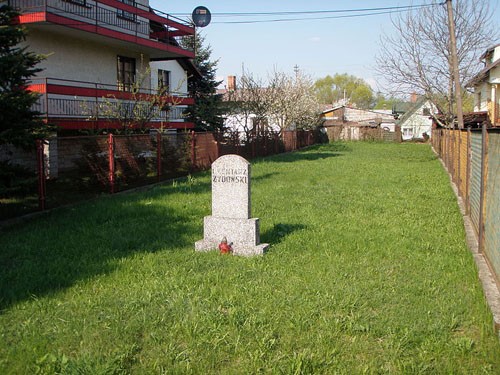
Both Jewish cemeteries in Augustów, the Old cemetery (also used as the ghetto burial ground) and the New cemetery, which were devastated during World War II, are renovated today. At the New cemetery, a monument was built to commemorate the Jews of Augustów and the Augustów Land. Meanwhile, the Old Jewish cemetery, which contains the remains of the ghetto victims, is now enclosed by a gated metal fence. Although this site features several tombstones and a monument marking the area as a Jewish cemetery, it lacks a dedicated memorial for the victims who perished during the Second World War.
For more information about the killings of Jews from Augustów in Szczebra, please follow the corresponding profile.
Do you have additional information regarding a village that you would like to share with Yahad ?
Please contact us at contact@yahadinunum.org
or by calling Yahad – In Unum at +33 (0) 1 53 20 13 17