

2 Killing site(s)
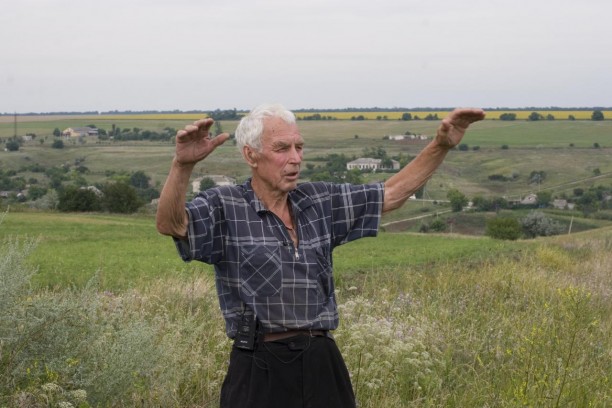
Ivan D., born in 1928: "The Jews were shot in groups of four or five by three shooters, at least one of whom was a Volksdeutsche volunteer. Wearing German uniforms and armed with German rifles, they forced the victims to line up facing the silo pits. As they were shot, the victims fell directly into the pits, while anyone who fell to the side was thrown in by the shooters. By the end of the shooting, both silo pits were completely full with bodies, but many victims were only wounded, not dead. Meanwhile, the village brigadier had requisitioned local residents and their horses to gather straw from the nearby fields. They deposited it about five to ten meters from the killing site. After the shooting, the perpetrators covered the pits with this straw themselves and set them on fire. They left immediately after lighting the fire, which burned for two or three days until the bodies were completely consumed. Due to the intense smell, these pits were later filled in with earth using a bulldozer. Today, the site is a wasteland right next to a cultivated field." (Testimony N°YIU1241U, interviewed in Balaichuk, on July 24, 2011)
"Soviet citizens from Western Ukraine and the city of Odesa had been placed in the ‘17th Party Congress’ kolkhoz. On March 14, 1942, German colonists arrived, led by a German officer. After gathering everyone in a kolkhoz barn, they began the shootings. They shot them on the western side, about fifty meters from the village, in a ravine above the silo pits. The people were stripped down to just their underwear. The bodies of those shot, some of whom were only wounded, were covered with straw, doused with gasoline, and burned. Among those shot were women, young children, and the elderly. In total, 270 people were shot. The commission established that 193 children were among the victims." [Act No. 5 drawn up by the Extraordinary State Soviet Commission (ChGK), on October 11, 1944, in the village of Balaichuk; Copy USHMM RG.22-002M, Reel 6 (29), p.25]
"Soviet citizens from Western Ukraine and the city of Odesa had been placed in the ‘Lenin’s Way’ kolkhoz. On March 14, 1942, German colonists arrived, led by a German officer. After gathering everyone in a kolkhoz barn, they began the shootings. They shot them on the western side of the village, in a ravine […]. The people were stripped down to just their underwear. The bodies of those shot, some of whom were only wounded, were covered with straw, doused with gasoline, and burned. Among those shot were women, young children, and the elderly. 1030 people were shot, including 610 children." [Act No. 7 drawn up by the Extraordinary State Soviet Commission (ChGK), on October 11, 1944, in the village of Balaichuk; Copy USHMM RG.22-002M, Reel 6 (29), p.27]
Balaichuk, located in the Berezivka district of the Odesa Oblast, lies approximately 85 km (52.8 mi) north of Odesa. Following the revolution, the region became part of the Ukrainian Soviet Socialist Republic. During the Soviet period, notably in the 1920s and 1930s, the area underwent significant agricultural development, leading to the re-organization of local settlements and the creation of collective farms (kolkhozes).
The Berezivka district was characterized by a significant presence of Jewish agricultural colonies, as well as numerous ethnic German settlers, known as Volksdeutsche. In the village of Balaichuk itself, several kolkhozes existed during the Soviet period, including Ukrainian kolkhozes and one Jewish kolkhoz. According to the 1939 Soviet census, 800 Jews lived within the wider Berezivka district, although the exact number of Jewish residents living specifically in Balaichuk on the eve of the Second World War remains unknown.
Balaichuk, like the rest of the Berezivka district, was occupied by German troops in early August 1941 and, at the end of the same month, was transferred to the Romanian civilian administration as part of the Transnistria Governorate.
In the winter of 1942, a number of Jews from Odesa, Western Ukraine, and according to additional sources, from Romania, were brought to Balaichuk. Upon arrival, they were confined to five empty kolkhoz (collective farm) barns under the supervision of several guards. The Jewish detainees were permitted to go into the village to look for food, which they often exchanged for clothing or money, while local residents also frequently brought food directly to the barns. Presumably, local Jewish residents were confined there alongside the others. Ivan D., born in 1928, a local witness interviewed by Yahad - In Unum, recognized his own neighbors from Balaichuk among the prisoners in the barns.
In March 1942, the Jewish detainees were killed over the course of several Aktions conducted by ethnic German colonists from the nearby settlements of Mostove and Zavadivka. Historical records offer varying figures regarding the scale of the massacres. An information report from the inspector of the gendarmerie in Transnistria states that 875 (and/or 850) Jews were shot in Balaichuk on March 10, 1942. Soviet archival data, however, indicates that 1,300 Jews were shot in the village on March 14, 1942. This total includes 270 victims shot in the silo pits and 1,030 victims killed in a ravine. Another group of 30 Jews was killed on March 24, 1942. During field research, a Yahad team identified both killing sites in the two silo pits and the ravine.
Ivan D., born in 1928, described the killing process at the silo pits, which, according to his account, was a main killing site of Jews in Balaichuk. He recalled that the victims were taken from the barns in groups of five or six and marched to an empty building, where they were forced to strip to their underwear. From there, they were led to two silo pits and shot. While one group was being shot, the next was already being prepared to follow the same procedure. Afterwards, the victims’ belongings were taken away in carts, and their bodies were burned.
Various sources estimate the total number of Jewish victims killed in Balaichuk to range from 1,300 to over 3,000. Today, a monument has been erected to commemorate the Jewish victims, including the women, children, and elderly who were killed in Balaichuk.
Do you have additional information regarding a village that you would like to share with Yahad ?
Please contact us at contact@yahadinunum.org
or by calling Yahad – In Unum at +33 (0) 1 53 20 13 17