
1 Killing site(s)
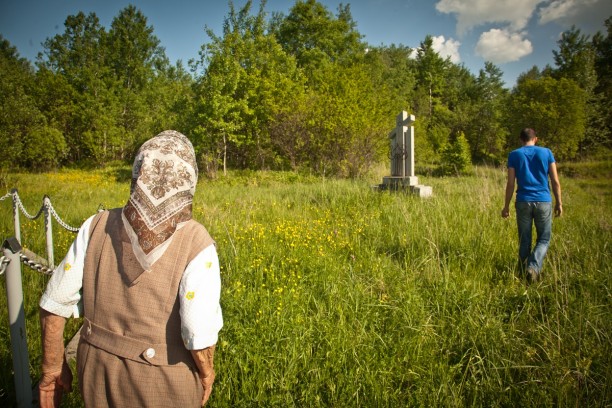
Mykola H., born in 1930: "Before the war, only a small number of Jewish families lived in Holobutiv. I remember three in particular: the families of Shmilo, Chaim, and the Chubkevytches. They lived modestly, looking after their homes and farms much like everyone else in the village.
The Jewish families gathered to pray, especially in the autumn. Chaim (their rabbi) led the prayers. On those days, his wife would not light any fire in the kitchen. Instead, she would ask us children to help, and afterward she always gave us a special holiday dish: a flat dough with holes poked into it with a fork. It was very tasty. Chaim made his living buying and selling horses. He would tie several horses together and take them to the market in Stryi.
Shmilo, another Jewish resident, had a son named Berko, who worked as a painter. Together they walked from house to house buying young calves to resell. Shmilo’s other son, Mayer, was a carpenter. I also remember a man named Wiesenberg, a landowner; when the Soviets came in 1939, they confiscated his property.
When the Germans arrived, the Jews continued to live in Holobutiv for some time, maybe two months or more. But eventually, they were forced out and taken to the Stryi ghetto." (Testimony N°YIU2996, interviewed in Holobutiv, on November 18, 2021)
"During the Nazi occupation, I lived in Stryi. […] Around September 1, while Jews were still living throughout the city, the first Aktion to annihilate them took place. Led by three Gestapo agents from Drohobych, Ukrainian police units arrested 830 people, mostly men. They were taken to Holobutiv and shot.
[…] The final Aktion began on June 5 with the liquidation of the ghetto. During this operation, the leaders Hutterer, Mischel, and Schindler were killed near the gates of the Jewish Council. I was rounded up on June 5 and held in a cell with 75 other people, without food, until June 7. On that day, we were transported to a forest in Holobutiv, where the massacre took place. Only Germans carried out the shooting. First, they killed the adults; then they began murdering the children. […]
This is how I escaped. In prison, they had already taken my outer clothes and shoes. In Holobutiv, they stripped us naked once again. The pit where the shootings took place was located on high ground; we undressed at the foot of the hill, then were led naked toward the pit. The forest around the site was encircled by Ukrainian police.
When they brought me there, eight vehicles from the prison had already arrived, all filled with victims. They stripped me naked and placed me in a group of ten. Halfway to the pit, I decided to break away. I lunged at a policeman who seemed distracted, grabbed him by the throat, and began to strangle him. His rifle flipped and discharged, shooting him in the leg. At that moment, a Gestapo officer ran to assist him, but I managed to twist free, grab the officer’s arm, and knock him off balance. When he dropped his submachine gun, I struck him on the head with it, knocking him out, and ran.
They opened fire on me and unleashed the dogs, but I fought back. When I reached the forest, I killed one of the dogs by striking it on the head with the gun. That is how I looked when I arrived in Holobutiv—bloody, barefoot, and naked.
I went to a local resident, Vasia Kiev, originally from Nezhukhov, and asked him for clothes. He gave me a jacket and a pair of work trousers. That is how I managed to escape execution." [Interrogation report of witness Heinrich Arnoldovich Wolfinger, born in 1903. Jewish. No criminal record. Drawn by State Extraordinary Soviet Commission (ChGK), on December 14, 1944. GARF 7021-58-21 p.131-135/Copy USHMM RG.22-002M]
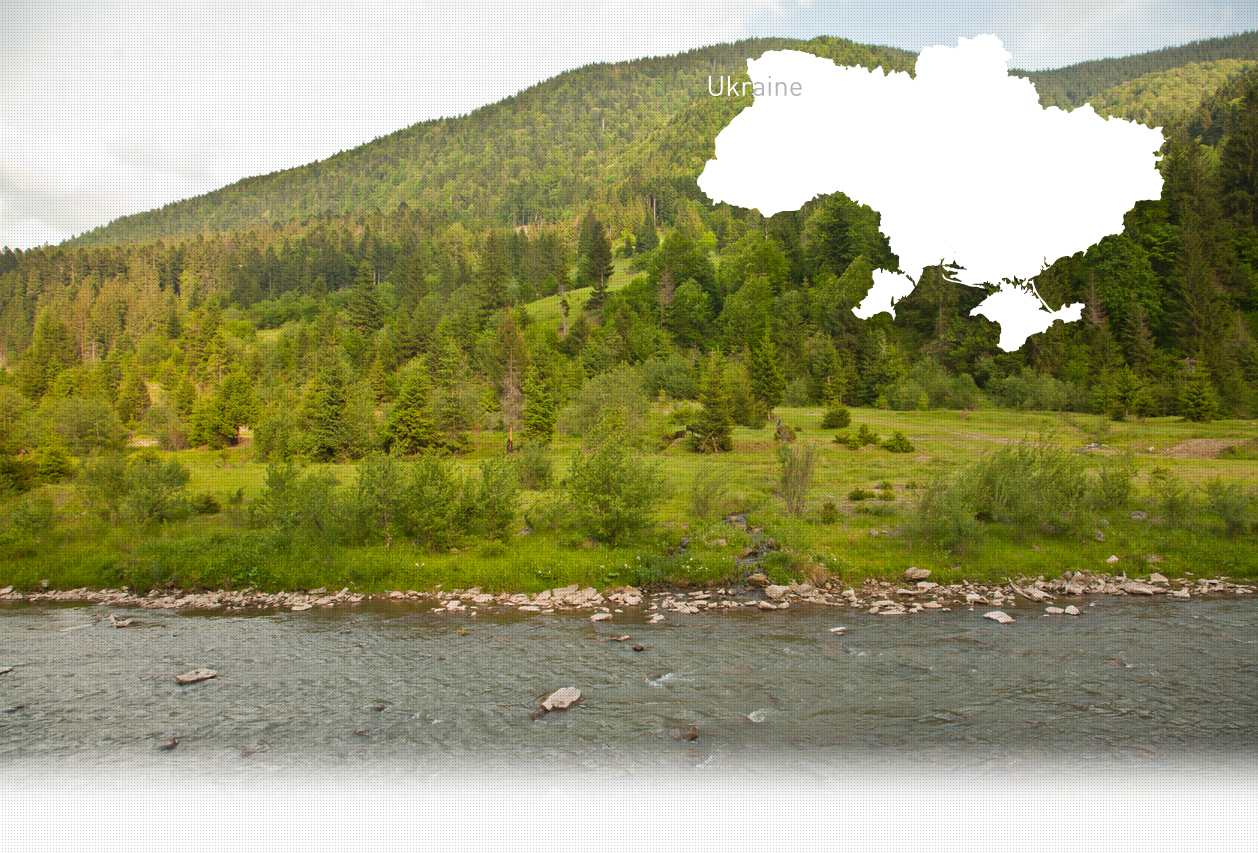
Holobutiv is a small rural settlement in the Lviv Region, located roughly 10 km (6.2 mi) from the district center of Stryi. Holobutiv first appears in the historical records in 1461. Holobutiv’s small rural, Jewish community was much smaller than that of Stryi. In 1935, the village had 182 houses inhabited by 750 Ukrainians, 70 Poles, 15 Germans, and 10 Jews. Mykola H., born in 1930 and interviewed by Yahad in 2021, recalled four Jewish families living in Holobutiv before the Second World War: the Shmil, Chaim, Chubkevych, and Wiesenberg families.
Economically, the Jews of Holobutiv worked in trades characteristic of small rural communities, while maintaining strong commercial ties to Stryi. Chaim was a horse trader who brought horses to market in Stryi. Wiesenberg, a landowner, managed a substantial estate featuring a spirit distillery as well as horse and cattle operations. Shmilo’s son Berko was a painter who also traded calves; his other son, Mayer, was a carpenter.
Holobutiv had no synagogue or cemetery of its own, but, according to Mykola H., Chaim maintained a modest home-based prayer space that served as a focal point for religious practice in the village. Mykola recalled that the Jewish families observed the Sabbath and Jewish holidays, and that Ukrainian villagers sometimes assisted them with tasks prohibited on sacred days. For more formal religious and communal needs—such as synagogue services, ritual life, and burial practices—Holobutiv’s Jews relied on Stryi, one of the most significant Jewish urban communities in eastern Galicia, whose institutions served the wider district. Because Holobutiv did not have its own Jewish school, Jewish children likely pursued their studies in Stryi, further strengthening the connection between the two communities.
Holobutiv was occupied by the Germans in September 1939. Following the signing of the Molotov–Ribbentrop Pact, however, the territory came under Soviet control. The Soviets quickly banned private property and nationalized businesses. Mykola H. recalled in particular that during this period the family of the landowner Wiesenberg was dispossessed by the authorities.
Holobutiv was occupied by German troops on July 3, 1941. In August 1941, a German civil administration took control of Stryi and the surrounding villages, including Holobutiv.
Around September 1, 1941, approximately 1,000 Jews were arrested. In the following days, some died as a result of torture inflicted in the Stryi prison. On September 15, 1941 (according to other sources, on September 22–23, coinciding with Rosh Hashanah), the first mass killing Aktion was carried out in the Holobutiv Forest. On that day, between 830 and 1,000 Jews detained in the Stryi prison were loaded onto trucks and taken to the forest to be shot.
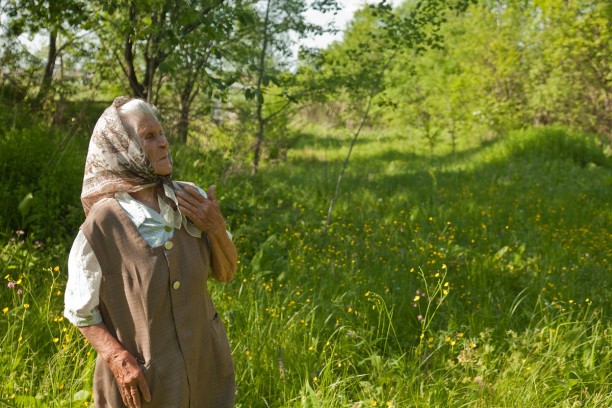
According to Olga S., born in 1926 and interviewed by Yahad, she was walking home from work through the Holobutiv Forest one autumn day when she saw a truck carrying Jews—men, women, and children. The victims were ordered to undress and line up in pairs before being taken to the top of a hill where, she recalled, four large pits had been dug. Olga and her friends stood less than 50 meters away when the shooting began. The victims were forced to stand in groups with their backs to the shooters, who shot them in the back of the neck. Those awaiting their turn stood nearby and could see everything. German SD soldiers carried out the shooting, while Ukrainian policemen formed a security cordon around the site. Olga also remembered the presence of the Baudienst, who were forced to fill in the pits afterward. Several victims were only wounded, and she recalled seeing the ground continue to move as the pits were covered. Because of this, the site was guarded until the movement stopped.
Another Yahad witness, Mykola H., born in 1930, was working in a nearby field when he saw four or five open trucks transporting Jews, about twenty people of all ages in each. German soldiers in blue uniforms escorted the convoy. He saw the victims being undressed at the foot of a hill near the home of a woman named Bobovochka before they were led toward the pits. From his vantage point, he could not see the exact killing site, but he heard bursts of gunfire. He also saw one Jewish man attempt to escape, only to be shot by a German soldier. After the shootings, the victims’ clothing was loaded onto trucks and taken to Stryi.
At the end of 1941, an open ghetto was established in Stryi, and Jews from surrounding villages—including Holobutiv and Nezhukhiv—were relocated there. Olga S. recalled seeing trucks arriving to take the Jews of Holobutiv away, including the family of the landowner Wiesenberg.
The second Aktion in the Holobutiv Forest took place on February 28, 1943. A few days earlier, the Stryi ghetto had been surrounded by German forces. At dawn on February 28, soldiers arrested Jews deemed unfit for work, including women, children, and the elderly. Those who attempted to flee were killed on the spot. The others were taken in groups from Stryi to the Holobutiv Forest, where they were shot by the Security Police and SD, assisted by the Ukrainian Auxiliary Police. Nearly 1,000 Jews were killed during this Aktion, which lasted until March 2 or 3, 1943.
The liquidation of the Stryi ghetto occurred on June 3–7, 1943. Raids were carried out to find Jews hiding both in the ghetto and across the city. These Jews were locked in the municipal prison for several days without food or water. The Jewish medical staff, who lived in a separate building, were also among those arrested. In prison, the Jews were ordered to remove their outer clothing and shoes. They were then transported by truck to the Holobutiv Forest. On the way, some doctors and members of their families poisoned themselves. Upon arrival, the victims—men, women, and children—were forced to undress completely, lined up in groups, and led to the edge of a mass grave, where they were shot by German municipal police and members of the Security Police and SD. During the Aktion, the forest was cordoned off by the Ukrainian Auxiliary Police. The shootings lasted several hours, with trucks constantly shuttling between the prison and the killing site. Nearly 3,000 people were murdered that day.
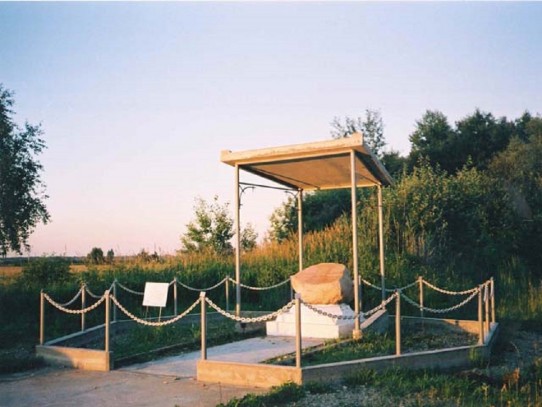
In total, approximately 5,000 Jews from Stryi, Holobutiv, and the surrounding villages were shot in the Holobutiv Forest. In 1998, the Jewish organization Kadima installed a commemorative plaque at the site, and in 2003 a permanent memorial was erected there.
Holobutiv was liberated in April 1944. Only a few Jews—those who had managed to hide or who had been evacuated—returned after the war.
For more information about the killing of Jews in Stryi, please refer to the corresponding profile.
Do you have additional information regarding a village that you would like to share with Yahad ?
Please contact us at contact@yahadinunum.org
or by calling Yahad – In Unum at +33 (0) 1 53 20 13 17