

1 Killing site(s)
Kateryna V., born in 1929: "The Jews, including small children, were brought on foot to our village from the direction of Balaichuk, though they were originally from Odesa. They arrived with few belongings, carrying only their clothes and personal items. When they got here, they were confined to an empty kolkhoz (collective farm) stable on the outskirts of Onorivka, surrounded by an enclosure and supervised by guards. While they slept inside the stable, they stayed in the outdoor enclosure during the day. The villagers would bring them food, such as bread and blinis. To feed themselves and their children, the Jews bartered their clothing, exchanging items like jackets or shirts for these provisions. I also went there to provide food to those I had come to know, including two young women from Odesa, Rita and Ania, who were between 18 and 20 years old. One day, while I was there bringing food, the stable was surrounded by ethnic Germans and the shooting began. I was saved by a local policeman who pointed out to the Germans that I was from the village." (Testimony N°YIU1273U, interviewed in Onorivka, on August 3, 2011)
"On February 15, 1942, Soviet civilians from Western Ukraine and the city of Odesa were brought to the village of Onorievka [today Onorivka], part of the Onorievka Village Council in the Berezovka [today Berezivka] district. Numbering 400, they lived for a month or more in the stables of the village of Onorievka. On March 13, German colonists arrived from the village of Neikovo [today Neikove] and shot 364 people with rifles, though some managed to escape. Among the victims were small children, women, the elderly, and men. They were brought to a hill next to the cemetery, to a location where a silo pit was situated. The Soviet civilians of Jewish nationality were lined up in groups and shot. Romanian gendarmes arrived after the execution. Before the shooting, the German colonists subjected young girls and small children to abuse. The surnames of the victims remain unknown. There were 130 children among them." [Act No. 20 drawn up by the Extraordinary State Soviet Commission (ChGK), on October 10, 1944, in the village of Onorievka, Berezovka district; Copy USHMM RG.22-002M, Reel 6 (29), p.38]
Onorivka, located in the Berezivka district of Odesa Oblast, lies approximately 90 km (55.9 mi) north of Odesa. The settlement was founded in 1860 under the Russian Empire as part of the agricultural expansion established by the tsarist authorities. The Berezivka district was also characterized by a significant presence of ethnic German settlers, known as Volksdeutsche. Following the Revolution, the region became part of the Ukrainian Soviet Socialist Republic. Although several Jewish agricultural colonies existed in the wider Berezivka area, available sources indicate that there were no Jewish residents living in Onorivka on the eve of the Second World War.
Onorivka, like the rest of the Berezivka district, was occupied by German troops in early August 1941 and, at the end of the same month, was transferred to the Romanian civilian administration as part of the Transnistria Governorate.
On February 15, 1942, 400 Jews from Odesa and Western Ukraine, including adults and children, were brought to Onorivka. Upon arrival, they were confined to an empty kolkhoz (collective farm) stable located on the outskirts of Onorivka, which was surrounded by an enclosure and supervised by guards. During their (approximately) one month stay in Onorivka, Jewish women went to nearby houses to ask for food, and local residents also frequently brought food to the people held in the stable, often exchanging it for clothing.
On March 13, 1942, ethnic Germans from the village of Neikovo, known as Volksdeutsche, arrived in the village and surrounded the stable. In groups of 10 to 15, the Jews were removed from the stable, forced to undress down to their underwear, and marched to a hill not far from the cemetery. There, they were shot at the edge of an empty silo pit. According to the Yahad - In Unum witness Kateryna V., born in 1929, the shooting was carried out by ethnic Germans and local policemen who were forced to participate. Anyone who tried to escape was captured and killed on the spot, after which their bodies were taken back to the pit.
After the shooting, flammable liquid was poured into the pit and set on fire, and the victims’ belongings were loaded onto a truck and taken away. Some time later, the pit was filled in with earth.
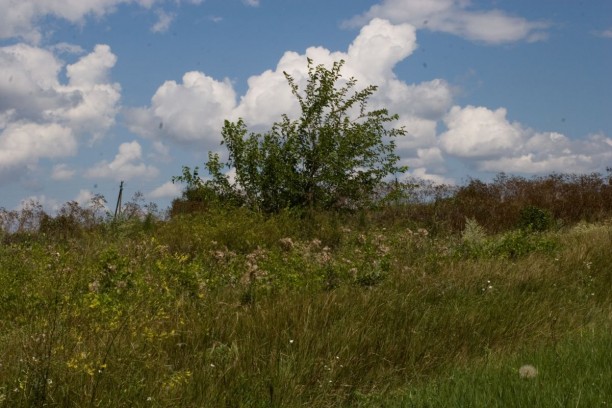
Archival sources indicate that a total of 364 people, including 130 children, were murdered over the course of the Aktion. Only a small number of Jews managed to escape. As of today, the killing site remains un-commemorated and overgrown with vegetation.
Do you have additional information regarding a village that you would like to share with Yahad ?
Please contact us at contact@yahadinunum.org
or by calling Yahad – In Unum at +33 (0) 1 53 20 13 17