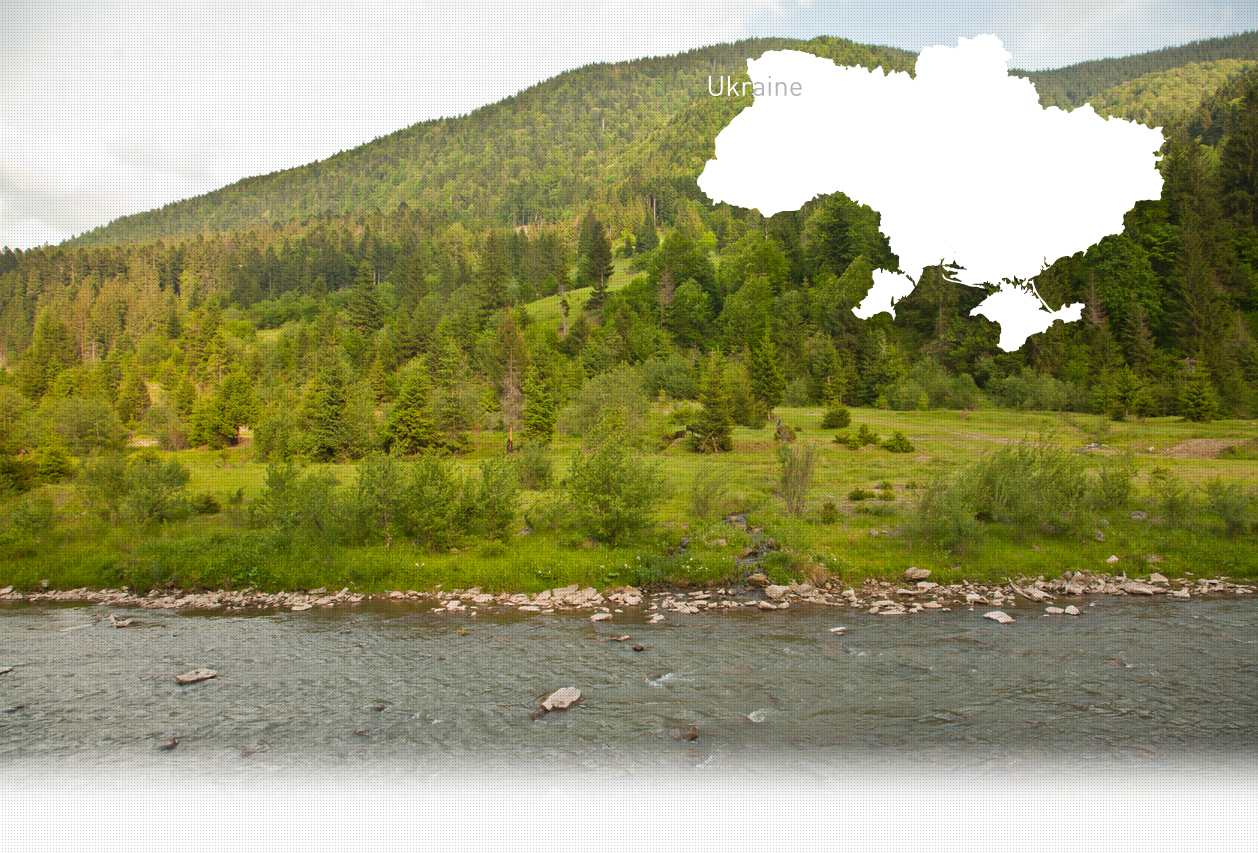


1 Killing site(s)
Zynoviy O., born in 1931: "A labor camp for Jews was set up in Pluhiv. Jews were brought there from across the entire district. I do not know whether both men and women were held there. Personally, I never saw women or children working, only men. They were forced to build roads, because at that time the roads were simply packed dirt and quickly became impassable.
After the German defeat at Stalingrad, they became furious. That was when the camp was liquidated. All the Jews in the camp were shot in a single day. The shooting began at dawn and was over by the afternoon. A very long pit, about forty meters long, had been dug near the camp, probably not by the Jews themselves, though I do not know for certain.
The Jews were forced to undress completely and were led toward the pit in small groups of five or six people. I saw only a short part of the shooting, because we were driven away by the Germans." (Testimony N°144YIU, interviewed in Pluhiv, on August 03 2005)
"[…] 1. Three doctors were shot by the Germans in Pluhiv in the Zolochiv district. […]
2. Three people were hanged in Pluhiv by the Camp Commander, Ch***.
3. Eighteen people died as a result of torture.
4. Three people were shot with machine guns by the Germans.
5. Fourteen people were killed in Pluhiv by [illegible].
6. Three prisoners of war were shot by German fascists.
7. Nine people were tortured to death by German fascists. […]"
[Act drawn by State Extraordinary Soviet Commission (ChGK), on November 17, 1944, p.53; GARF 7021-67-84/Copy USHMM RG.22-002M]
The village of Pluhiv is located in present-day Lviv Oblast, in the Zolochiv District of Ukraine. The settlement is first mentioned in written sources in 1469.
Available sources do not specify when a Jewish community was first established in the village. Documented statistical data indicate a small Jewish presence. In 1900, municipal records list 75 Jews in Pluhiv. In 1921, official data record 36 residents of the Jewish faith in the village.
The main occupations of the Jewish residents were crafts and trade. They also formed part of the village intelligentsia, including medical professionals. Volodymyr Sh., born in 1925, recalls a very good Jewish dentist.
In September 1939, Pluhiv came under Soviet control following the advance of the Red Army and the Soviet annexation of eastern Poland. As in other territories annexed by the Soviets, private property was abolished and religious life was suppressed, affecting Jews as well as other religious communities.
Pluhiv was occupied by German forces in the summer of 1941. As part of German rule in Galicia, Jews were subjected to anti-Jewish measures implemented throughout the district, including the deprivation of civil rights, forced labor, confiscation of property, registration, and segregation.
A Jewish labor camp was established in the stables of a former Polish estate in Pluhiv in October 1941, where inmates were exploited for road construction and other forms of forced labor. According to some local sources, Jews from the labor camp also worked for a firm identified as ‘Gobeck.’
Between late 1941 and mid-1942, a number of Jews from several towns in eastern Galicia were relocated by the German authorities to the labor camp in Pluhiv. The first documented transfers took place in the autumn of 1941, when groups of Jewish youth from Toporiv were sent to labor camps in Pluhiv and nearby towns. On December 27, 1941, several large groups of Jews from Brody were sent to labor camps in Pluhiv, Lackie Wielkie, Iaktoriv, and Zboriv. During the winter of 1941–1942, more than 100 young Jewish men from Radekhiv were sent to Pluhiv, and none ever returned. On May 5, 1942, a major deportation Aktion took place in Jaworów, during which approximately 500 Jews were sent to Pluhiv. Those deemed unfit for labor were murdered upon arrival.
Three days later, on May 8, 1942, approximately 800 Jewish men aged 15 to 55 were rounded up in Gródek Jagielloński. They were first sent to the Janowska Street labor camp in Lviv, and from there many were transferred to other labor camps, including Pluhiv.
According to accounts from local witnesses interviewed by Yahad, a number of Jews died from exhaustion in the camp. Local sources, survivor accounts, and eyewitness testimonies indicate that a liquidation Aktion of the Pluhiv labor camp took place on July 22, 1943. Several witnesses linked this Aktion to the broader context of German military reversals following the defeat at Stalingrad, although this connection is based on later recollections rather than contemporaneous documentation.
Volodymyr Sh., born in 1925, provided an eyewitness account of the events. He reported that units wearing black uniforms with skull insignia arrived in the village by truck and established a cordon around the camp, which was located on the former estate of a Polish landowner. According to his testimony, the Jewish prisoners were forced to undress completely and were led in small groups, sometimes as family units, toward a pit situated in close proximity to the camp, where they were killed by machine-gun fire.
Sofia D., born in 1919, stated that the pits were dug by Jewish prisoners and local villagers. Her husband had been requisitioned for this work and described the presence of four elongated pits at the killing site.
According to eyewitness testimonies, the liquidation of the camp lasted only half a day, and the Jewish prisoners were killed on site. Eyewitnesses estimate the number of victims to be between 500 and 800. On the day of the shooting, the Germans attempted to keep certain indispensable specialists alive, such as physicians. Volodymyr Sh. remembered an excellent dentist to whom, according to testimony, the Germans offered to spare his life. He refused, as his entire family had been killed.
According to the researcher Ilya Altman, a significant portion of the Jewish prisoners were transferred to another labor camp located in Iaktoriv, while approximately 600 Jews died in the Pluhiv camp during the war.
After the liberation of the village, a sovkhoz (state farm) was established on the site by the Soviet authorities. No memorial marks the killing site, and there is no plaque indicating the former presence of a labor camp.
Do you have additional information regarding a village that you would like to share with Yahad ?
Please contact us at contact@yahadinunum.org
or by calling Yahad – In Unum at +33 (0) 1 53 20 13 17