.jpg&f=jpg)
.jpg&f=jpg)
.jpg&f=jpg)
.jpg&f=jpg)




1 Killing site(s)
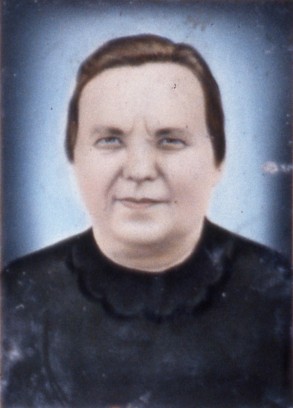
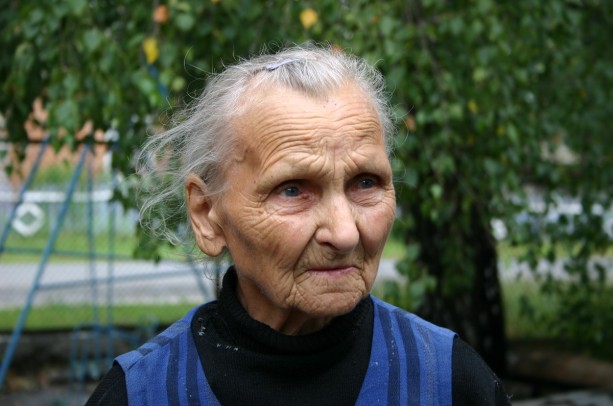
Nina O., born in 1922: "Jews lived in the town center and ran shops. We had good relations with them. They could find any product we needed, and they could also lend money. They were good people. We went to school together.
When the Germans arrived, they set up the ghetto in the town center. Jews were marked with yellow fabric on their shoulders. Young Jews were forced to work, and it was forbidden to give them food, under pain of death.
Before the shootings, the Germans asked how many Jews there were. Then they went to the Jewish cemetery and measured how long the pit would have to be. Local people were requisitioned to dig it, and the young Jews were forced to finish digging it.
The Jews were brought in trucks. People said that mothers kissed their children before they were shot in the back of the neck. The Germans measured the pit precisely, and by the time the Jews from the last truck were shot, the pit was full.
One young woman had managed to hide, but she was found and killed. I saw her body being taken to the Jewish cemetery. Her arm was hanging from the cart and swinging back and forth." (Testimony N°YIU447U, interviewed in Torchyn, on March 30, 2007)
Torchyn is a village in the Volyn region, located approximately 25 km (15 mi) from Lutsk. It is first mentioned in written sources in 1093, long before the documented emergence of a Jewish community in the 16th century. In the centuries that followed, the Jewish population experienced periods of anti-Jewish violence, notably during the Cossack uprising of 1648–1649.
After the Partitions of Poland, under Russian imperial rule, the Jewish population grew steadily. In 1847, approximately 1,748 Jews were recorded in Torchyn; by 1897, this number had risen to around 2,629, making Jews a significant proportion of the town’s inhabitants. This demographic growth was accompanied by active economic participation. Jews operated numerous shops, tanneries, and artisanal workshops and played a central role in local commerce.
During the interwar period, when Torchyn was part of the Republic of Poland, Jewish communal life was dynamic and diverse. It included political organizations such as the Bund and various Zionist parties, youth movements including Beitar, and educational institutions such as a Hebrew-language Tarbut primary school alongside traditional religious schools (ḥadarim and Talmud Torah). Jewish cultural, civic, and economic life was well organized and closely integrated into the town’s social fabric.
According to the 1921 census, Torchyn had 1,480 Jewish residents, representing approximately 46 percent of the total population. On the eve of the Second World War, in 1939, the Jewish population is estimated at between 1,600 and 1,700 people.
Following the German–Soviet Pact of September 1939, Torchyn was incorporated into Soviet Ukraine. Under Soviet rule, private businesses and independent communal activities were suppressed. Jewish entrepreneurs were deported, and the Tarbut school was closed and converted into a Soviet Yiddish-language school, reflecting broader policies aimed at dismantling religious, economic, and cultural autonomy.
Torchyn was occupied by units of the German 6th Army on June 24, 1941. Shortly thereafter, a new local administration was established, including a Ukrainian auxiliary police force. In September 1941, Torchyn came under German civil administration.
Beginning in the summer and autumn of 1941, anti-Jewish measures were implemented in Torchyn. These included forced labor assignments, such as laying cables. A Judenrat (Jewish Council) was established to enforce German orders within the Jewish population and was assisted by a Jewish police force.
Hryhori H., interviewed by Yahad - In Unum and a long-time researcher of Torchyn’s history, stated that the first mass shooting of Jews took place on Saturday, August 2, 1941. On that day, a group of Jewish men and several women, accused of collaboration with the Soviet authorities, numbering 375 or 376 according to his account (284 according to other sources), were taken to the Zelenevo forest near the village of Buyany and shot. The Aktion was reportedly carried out by a detachment of the Security Police from Lutsk and overseen by Wallendschus, the agricultural administrator and head of the Torchyn administration. Olga K., born in 1917, recalled hearing gunfire coming from the forest while she was harvesting wheat.
In February 1942, a ghetto was established in the old town, near a place known as Zastryzhzhia. Approximately 1,500 local Jews were confined in a small number of houses surrounded by barbed wire. Jews from nearby villages, including Shepel, Khorokhoryn, Zatutrsi, and others, were subsequently transferred to Torchyn, increasing the ghetto population to more than 2,000 people. Some sources estimate that it may have exceeded 4,000. Living conditions were extremely overcrowded, with severe shortages of food and potable water, aside from minimal rations distributed by the Judenrat or food obtained through clandestine barter with non-Jews.
Mykhailo, born in 1935, recalled seeing Jews from the ghetto wearing yellow pieces of cloth sewn onto their backs to mark them as Jews. They were subjected to forced labor, systematic confiscation of property, and strict restrictions on movement. According to his recollections, Jews were also forced to pay frequent contributions in gold to the German authorities, sometimes on a weekly basis.
In May 1942, approximately 150 Jewish young men deemed fit for work were deported to forced labor camps run by the Organisation Todt. Only a few are known to have survived these deportations.
On August 22–23, 1942, the Torchyn ghetto was liquidated during a large-scale Aktion carried out by a detachment of the Security Police and SD from Lutsk, with the assistance of the Gendarmerie and Ukrainian auxiliary police. Mykhailo, born in 1921 and interviewed by Yahad, recalled:
“German soldiers went into the villagers’ homes with the Starosta and told the men to take shovels and follow them, without any explanation. I was among about 80 residents taken to dig a pit at the old Jewish cemetery at the end of Sadovskaya Street. A German officer measured out 50 meters in length and 4 meters in width with his steps and ordered us to dig a pit that size and 3 meters deep.”
The Jews were then rounded up in the ghetto and transported to the Jewish cemetery in open trucks. According to witnesses interviewed by Yahad, they were forced to finish digging the pit begun by the local residents. Nadia, recalling her father’s account (he had been conscripted to dig) stated:
“The Jews went down into the pit by families, holding hands. Mothers kissed their children. They lay down in the pit, and a German walking on top of them shot them in the neck. A table stood near the pit with alcohol on it. The gunman drank, then shot the Jews.”
Approximately 2,000 Jews—men, women, and children—were murdered in the pit during this Aktion.
Several hundred Jews who initially escaped or went into hiding were captured and killed in the days and weeks that followed. Only a small number survived, either by hiding successfully or by joining partisan units. Mykhailo, born in 1921, also recalled witnessing a later, smaller shooting at the Jewish cemetery. A separate pit was dug next to the main one, where local police, this time without German participation, shot Jews who had managed to evade the first massacre. Nina O., born in 1922, similarly recalled seeing the body of a young Jewish woman who had been killed on the road being transported to the Jewish cemetery.
In February 1944, Torchyn was liberated by the Red Army, bringing the German occupation to an end. The Jewish community of Torchyn, however, was not reestablished after the war.
In 1960, a memorial was erected at the Jewish cemetery in Torchyn to commemorate approximately 4,000 Jews who were murdered there in August 1942.
Do you have additional information regarding a village that you would like to share with Yahad ?
Please contact us at contact@yahadinunum.org
or by calling Yahad – In Unum at +33 (0) 1 53 20 13 17