,_New_synagogue.jpg)




2 Killing site(s)
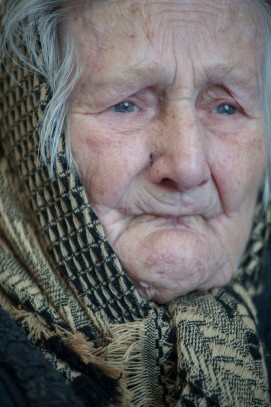
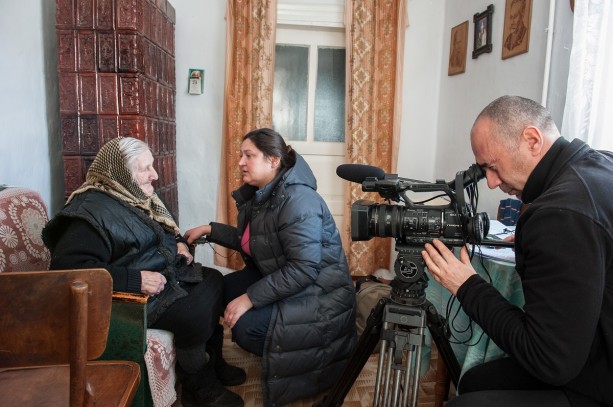
Olga S., born in 1929: "After the Germans arrived in Broshniv, Jews were no longer allowed to work. Soon afterward, a ghetto was established, and Jews were forced to wear a star on their chest and armbands. The ghetto consisted of several houses surrounded by barbed wire and guarded by policemen. After that, Jewish shops were looted… anyone who wanted could steal from them.
Some time later, Jews from Czechoslovakia were also brought to Broshniv on foot. They looked well-off and were very neatly dressed. When they arrived, they were confined in the ghetto together with the local Jews who were already there.
One day, on my way home from school, I saw a very large column of Jews, made up of hundreds of men, women, and children. They were being escorted to a place where the boys used to play football. Along with other passersby, I had to step off the road to let the column pass.
Once there, the Jews were forced to dig a pit. Then they were lined up and shot by the Germans. The shooting went on all day… We could hear gunfire until the evening." (Testimony N°YIU2374U, interviewed in Iazlovets, on March 24, 2018)
" […] Shortly before the liquidation of the Zwangsarbeitslager (forced labor camp) of Ugerstal, I learned from peasants that a smaller camp located in Broszniow [today Broshniv] had been liquidated and that no Jew had been spared. I then decided, in May or June 1944, not to return from work but to flee to the town of Wojnilow, where I had lived, and I hid in the forest. […] We were liberated two months after my escape by the Russians. […]" [Testimony of Anna REICHBAR, a Jewish survivor, given in Tel Aviv on 2 November 1954; BARch162-4996]
Broshniv-Osada, located in Eastern Galicia in today’s Ivano-Frankivsk region, lies approximately 47 km (29 mi) from Ivano-Frankivsk and 17 km (10 mi) from Kalush. The settlement traces its origins to the neighboring village of Broshniv, which existed as early as the 16th century. The construction of the railway and the establishment of timber factories in the late 19th century led to the creation of a new industrial settlement known as Broshniv-Osada.
Over the course of the 20th century, the region changed hands several times. It formed part of the Austro-Hungarian Empire until 1918, experienced a brief Russian occupation between 1914 and 1915, belonged to the West Ukrainian People’s Republic from 1918 to 1919, and was subsequently incorporated into the Republic of Poland from 1919 until 1939.
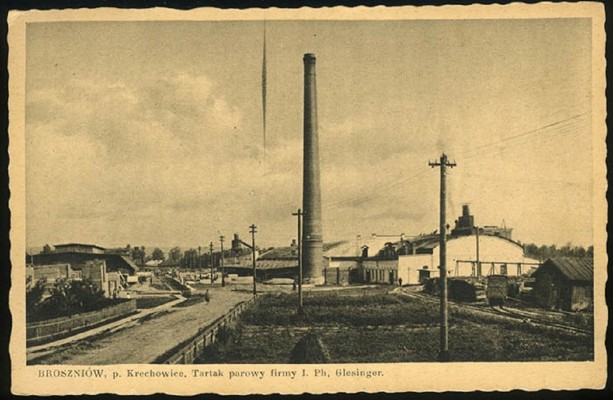
According to the 1921 census, Broshniv-Osada had 1,631 inhabitants, including 226 Jews, representing nearly 14 percent of the total population. Jewish life in the town was closely connected to the local industrial economy. Jews were active in commerce, crafts, and services, and played a particularly important role in the timber industry. Two major sawmills structured the local economy, one of which was owned by a Jewish entrepreneur associated with the Glesinger firm and employed a significant number of Jewish workers.
The community sustained an organized religious life, as evidenced by the presence of Rabbi Benzion Izchak Westreich in the 1930s. In 1931, a new synagogue was built. Notably, its architectural plans were sent from Mandate Palestine, reflecting ideological and cultural ties to the Zionist world. Alongside religious institutions, the Jewish community also maintained charitable organizations.
The interwar period was marked by strong cultural and educational activity. The Herzliah association, active in the late 1930s, operated a multilingual library with holdings in Hebrew, Yiddish, and Polish, while a Tarbut school promoted Hebrew-language education. Jewish youth were involved in Zionist movements, particularly Hechalutz, which was active in Broshniv by 1934. Local groups of chalutzim cooperated with regional committees in Lviv, and some community members emigrated to Palestine during the 1920s and 1930s, including to Kfar Saba.
In 1939, following the signing of the Ribbentrop–Molotov Pact, the region came under Soviet occupation, which lasted until 1941. This period profoundly affected the economic, cultural, and religious life of the town, including that of its Jewish community.
On the eve of the Second World War, Broshniv-Osada had approximately 1,980 inhabitants, including around 240 Jews, alongside 1,380 Poles, 300 Ukrainians, and 60 Germans. Although a demographic minority, the Jewish community remained an economically integrated, culturally dynamic, and socially significant part of the local population.
Following the launch of Operation Barbarossa in June 1941, Broshniv-Osada came under German occupation and was incorporated into the District of Galicia. From the outset of the occupation, Jewish civic, economic, and religious life was dismantled. Jews were subjected to discriminatory measures, including the prohibition of economic activity and the compulsory wearing of distinctive Star of David badges on the chest and armbands.
Shortly thereafter, Jews were confined to a ghetto consisting of several houses surrounded by barbed wire and guarded by policemen. Jewish shops were subsequently looted by local residents and the authorities. According to the testimony of Olga S., born in 1929, Jews from Czechoslovakia were later brought to Broshniv-Osada and confined in the same ghetto alongside the local Jewish population. It was possible to approach the ghetto in order to bring food to the Jews; thus, Vasyl P., born in 1936, recalls coming from a neighboring village to sell or barter food. Both Vasyl P. and Olga S. state that while confined in the ghetto, Jews were required to pay contributions in gold to the Germans, in exchange for promises that their lives would be spared.
Presumably in early autumn 1942, most of the Jews confined in the ghetto were murdered during an Aktion carried out by German forces with the participation of local policemen. According to accounts by local witnesses, several hundred men, women, children, and elderly people were escorted to a field near the sawmill. There, they were forced to dig a pit within a pre-existing natural trench and were subsequently shot in groups by the Germans. After the shooting, the pit was filled in, burying the victims, some of whom were still alive.
The remaining ghetto inmates—young Jews considered fit for labor who had been spared during the Aktion—were joined by a group of Jews from Dolyna and subjected to forced labor at the Glesinger sawmill, while being housed in nearby barracks. Some historical sources indicate that at least part of this group was employed by the German company Delta, particularly in construction-related labor.
These Jewish workers, numbering approximately 100 people, were murdered during a second Aktion. While witness testimonies sometimes date this event to the summer of 1942, it most likely took place in July 1943 or possibly later, in 1944. Under the direction of Assmann, head of the Kalush Gestapo, the Jewish workers were gathered in a fenced area near the sawmill’s lumber warehouse—a place that, after the murder of the Jews, became locally known as the “Hell Pit.”
According to witness testimonies, the massacre unfolded as follows: the Jews were ordered to report to a sawmill warehouse under a deceptive pretext, where German soldiers were already lying in ambush. Upon arrival, they were shot on the spot; no burial pit had been prepared. Students from a vocational school in Broshniv, also known as the Baudienst, were subsequently requisitioned by the Germans and forced to construct pyres by arranging layers of bodies alternating with layers of wood. The piles were then doused with fuel and set on fire. As a result, no burial pit was required, as the bodies were completely burned over the course of three days.
According to some historical sources, a number of Jews from Broshniv continued to work for the company Delta until the summer of 1944.
In this way, several hundred Jews from Broshniv, together with Jews from Dolyna and from Czechoslovakia, were murdered in Broshniv during the period of German occupation. To this day, both killing sites remain un-commemorated.
Do you have additional information regarding a village that you would like to share with Yahad ?
Please contact us at contact@yahadinunum.org
or by calling Yahad – In Unum at +33 (0) 1 53 20 13 17