



2 Killing site(s)
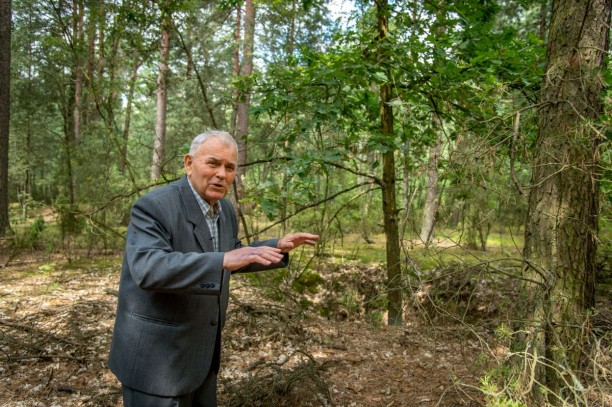
Władysław O., born in 1935: "The Jews were shot at the edge of the forest. At that time, it was just bushes, but the forest has grown since. There were about fifteen of them, from Miedzna and other places. They had to dig several pits themselves. All of them were killed in one day, their bodies covered with sand, the ground leveled, and then the Germans drove away." (Testimony N°YIU484P, interviewed in Miedzna, on July 30, 2015)
Questionnaire on mass executions and mass graves
"Location: Miedzna
Gmina (District): Miedzna
Powiat (County): Węgrowski
Voivodeship: Warszawskie
1/ Date and place of execution: January 1943, locality "Piaski Drażeńcowe"
2/ Type of execution /shooting, hanging, etc./: - shooting
3/ Data concerning the murdered:
Poles, Jews, foreigners: - Jews
Number of persons murdered: 35 persons
Where the victims were brought from: part of the victims were already on site, hiding from the Germans in the forest; part were brought from other unknown localities
Names, age, occupation, addresses: names unknown
4/ Is it known what the victims were accused of, was the execution a retaliatory order, etc.: the victims were murdered because they were of Jewish nationality
5/ Who carried out the execution /Gendarmerie, Gestapo, SS, police, Wehrmacht/: Gendarmerie
6/ Are the names of the perpetrators known /provide names/: - unknown
7/ Were the bodies burned or destroyed in another way /where/: the bodies were not destroyed
8/ Where were the bodies buried /exact location/: the bodies were buried on site, in the locality "Piaski Drażeńcowe"
9/ Description of the grave(s), dimensions of the grave, estimated number of victims in one grave: one common mass grave for 35 persons
10/ Was an exhumation carried out, officially /protocol/, where were the bodies buried: exhumation was not carried out
11/ Are there grounds for ordering a later exhumation: there are no grounds for ordering a later exhumation. No"
[Source: Court inquiries about executions and mass graves in districts, provinces, camps, and ghettos (Ankieta Sadów Grodzkich); RG-15.019M Reel # 14 part1]
Miedzna is a village in the Mazovian Voivodeship, Węgrów County, located along the Miedzanka River. The earliest historical mention of Miedzna dates back to 1441.
Jewish settlement in Miedzna grew during the 19th and early 20th centuries. By 1870, there were 92 Jews living in the village, a number that increased to 145 in 1874, 100 in 1890, 400 in 1921, and approximately 600 by 1939. The Jewish community maintained a house of prayer and played an important role in the local economy. They ran several businesses, including grocery stores owned by Ch. Celnikow, A. Goldsztejn, N. Szmklerz, and Zybernagiel; a dye works operated by P. Farbiarz; a tailoring workshop by P. Miljon; a dairy by Ch. Wajsberg; an oil press by D. Werner; a bakery by F. Erlich; and a windmill by M. Finkelsztejn.
Miedzna was occupied by German forces in September 1939. According to a Yahad witness, a German unit established barracks in the village.
In November 1941, 302 local Jews were relocated to the ghetto in Stoczek, where Jewish residents from other localities, including Prostyń and Stara Wieś, were also assembled. From there, the ghetto inmates, totaling approximately 2000 people, were deported to the Treblinka killing center during an Aktion carried out by German forces and auxiliary police units beginning on September 22, 1942.
Aware of their likely fate, a number of local Jews as well as those gathered in the Stoczek Ghetto managed to go into hiding in surrounding villages and forests. However, intensive searches continued in the area for many months, and the fugitives were progressively discovered and murdered. According to Polish archives, 35 Jewish residents were shot and buried in a single pit at the edge of the Miedzna forest in January 1943. Additional pits were reportedly located at the site as well.
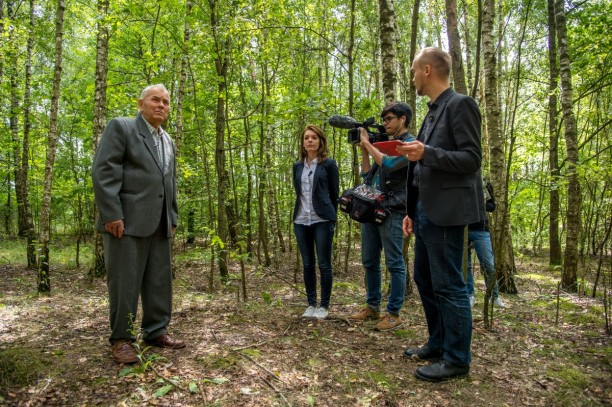
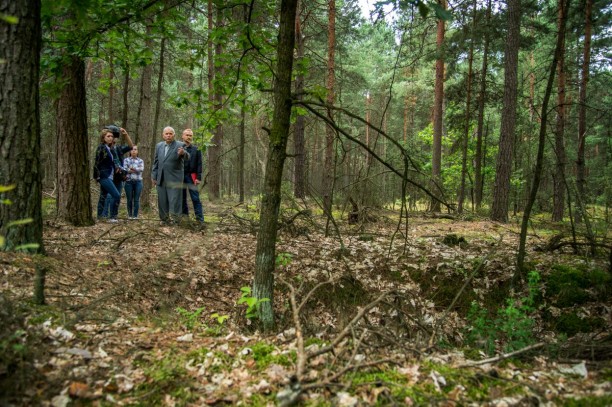
During the investigation in the area, two killing sites were identified with the help of a Yahad-In Unum witness, Władysław O., born in 1935. According to his account, the first pit, located at the edge of the forest, is the killing and burial site of approximately 15 Jews from Miedzna and the surrounding areas who were shot by the Germans in the fall of 1943. Władysław described a shallow pit measuring between 10 and 15 meters in length, which was dug by the victims themselves before they were executed.
The second killing site marks the location of an underground hideout used by approximately 10 Jewish men and women. During the winter of 1943, the group sought refuge in a solidly built and furnished bunker concealed beneath a juniper tree planted in a small bucket. To survive, they resorted to taking food from nearby farms, which aroused suspicion among local residents and alerted both the Polish police and German authorities. The hideout was eventually discovered when tracks in the snow led German forces directly to it. The Germans threw a grenade inside, killing at least seven individuals, and all of the victims were buried on the spot.
To this day, both identified killing sites remain uncommemorated.
Do you have additional information regarding a village that you would like to share with Yahad ?
Please contact us at contact@yahadinunum.org
or by calling Yahad – In Unum at +33 (0) 1 53 20 13 17